

European Research Project unlocks the future of immersive collaboration
The 6G-XR consortium partners Ericsson, the i2CAT Research Centre, Vicomtech, and Capgemini validate advanced experimental results that strengthen the foundation for next-generation Extended Reality (XR) services.


16.12.2025
The future of collaboration and Extended Reality (XR) is taking shape with the latest advancements from the European project 6G-XR (6G eXperimental Research infrastructure to enable next-generation XR services). Researchers from four key partners—the i2CAT Research Centre, Ericsson, Vicomtech, and Capgemini—have successfully validated two challenging use cases on the project’s infrastructure. This collaborative achievement confirms the potential of Beyond 5G (B5G) and 6G networks to deliver highly demanding immersive services, specifically real-time holograms and advanced XR services powered by edge computing.
Bringing Holographic Communication to Life: Uninterruptible Calls
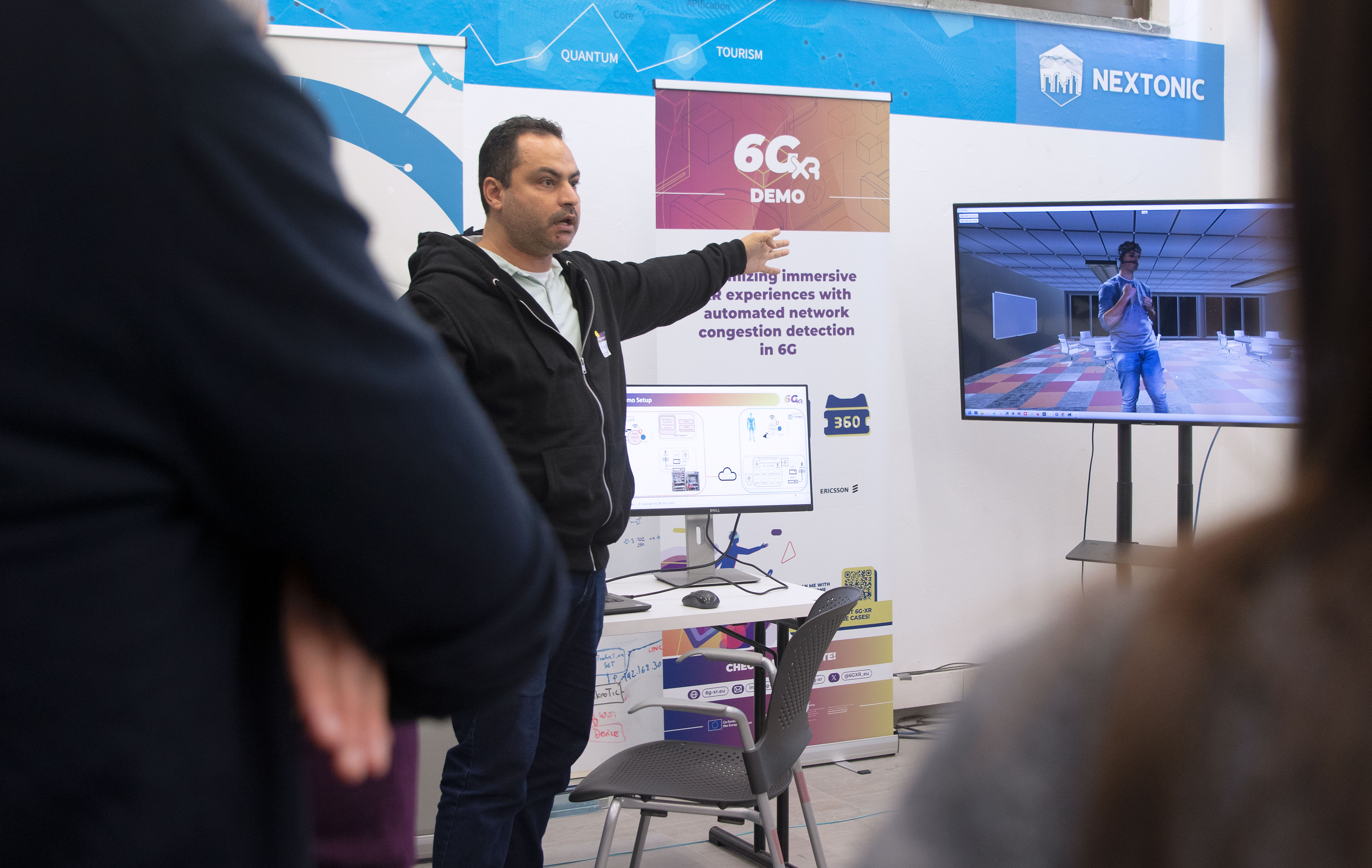
The first key demonstration, developed specifically by Ericsson and the i2CAT Research Centre, focuses on Real-Time Holographic Communications, a technology that promises to transform remote interaction. Ericsson and i2CAT delivered a live holographic communication session using i2CAT’s HoloMIT system across Barcelona and Madrid. The demo emphasized two key innovations designed to maintain holographic call quality, ensuring the conversation is never cut short, even under challenging network conditions:
-
Proactive Congestion Detection: A new algorithmic capability monitors network performance at the cell level, identifying in real-time when congestion is degrading the holographic stream. This function enables the application to react proactively to network issues, which is essential for delivering consistent, high-quality immersive communication.
- Intelligent Traffic Prioritization (CAMARA Quality on Demand - QoD): Upon detecting congestion, the system automatically triggers CAMARA QoD, which requests dynamic prioritization of the holographic traffic. QoD allows the network to allocate additional resources to the holographic flow when needed, significantly improving service continuity during congestion events.
With Ericsson’s 5GSA network providing coverage across Barcelona and Madrid, the demonstration showcased how combining application-level intelligence and network-level prioritization can ensure stable, low-latency holographic calling over long distances. This capability generates real impact in sectors like remote industrial maintenance and advanced education, where immediate, high-fidelity collaboration is critical.
Optimizing XR Services: Automated Edge Selection for the Best Experience
The second demonstration, developed by Capgemini, Vicomtech, Ericsson, and the i2CAT Research Centre, highlighted how XR services can automatically select the optimal edge node across the Barcelona–Madrid edge continuum.
This demonstration integrated the HoloMIT holographic technology from i2CAT, a Remote Rendering Technology for accessing XR services via lightweight end-devices developed by Vicomtech, Ericsson’s end-to-end adaptable network infrastructure and Capgemini’s IEAP (Intelligent Edge Automation Platform), orchestrating the edge resources in Barcelona and Madrid, and exposing the CAMARA Simple Edge Discovery API. This novel CAMARA API, exposed by the Capgemini’s IEAP, enabled the system to automatically select the most appropriate edge node to instantiate the Remote Renderer—either Barcelona or Madrid—based on factors like end-user location, latency, load, and resource availability.
The demonstration successfully proved how distributed XR applications can use standardized APIs to adapt dynamically to the underlying compute environment, ensuring an optimal and smooth user experience regardless of the physical geography.
Conclusion: Network Intelligence Drives the 6G Future
Together, the two demonstrations show how network intelligence, edge discovery, and application-level adaptability will truly shape the future of XR and holography. Holographic calls remain stable even under congestion, thanks to proactive detection and QoD prioritization. Furthermore, XR services will transparently select the best edge node, using standardized APIs and advanced rendering technology. These outcomes mark an important step toward making XR and holography deployable at scale in future 6G networks.
''Leveraging 6G edge computing and low-latency wireless communications, Vicomtech’s Remote Rendering technology shows how high-quality Extended Reality (XR) experiences can be delivered to any lightweight device. Developed within the 6G-XR initiative, this remote renderer plays a key role in bringing together networks and applications, helping make XR more accessible, scalable, and useful for a wide range of users", emphasizes the Senior Researcher in Digital Media and Communications at Vicomtech, Dr. Roberto Viola.