

LandaGO, paving the way for autonomous mobility in rural areas
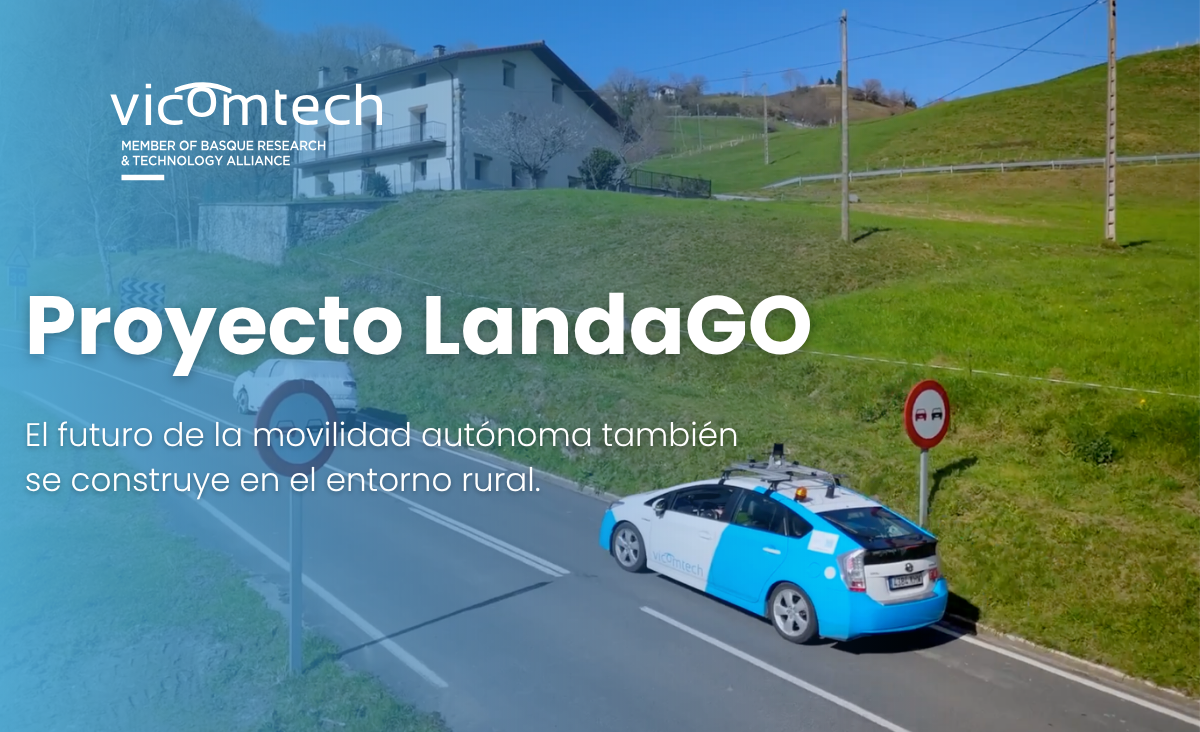
LandaGO is driving the development and validation of autonomous driving technologies tailored to rural environments, laying the foundations for the next generation of mobility solutions.


The Challenge
Rural areas face unique mobility challenges. Low population density, dispersed communities and limited public transport services make everyday travel more difficult for people living in these regions.
Bringing autonomous driving to rural roads presents a very different technological challenge from urban mobility. Narrow roads, steep gradients, sharp bends, changing weather conditions and the frequent presence of pedestrians, cyclists and animals require technologies capable of operating safely in highly demanding environments.
LandaGO was created to address these challenges. The initiative, promoted by the Provincial Council of Gipuzkoa, MUBIL and the Basque Government in collaboration with the technology consortium formed by Vicomtech, Eurogap and BasqueCCAM, aims to research and validate a new autonomous mobility model specifically designed for rural areas.
The Proposed Solution
Vicomtech is leading the development and validation of the key technologies required to enable the safe operation of autonomous vehicles on rural roads.
To achieve this, the technology centre is integrating advanced environmental perception systems into autonomous vehicles, combining cameras, LiDAR sensors, radars and high-precision positioning technologies to continuously interpret the vehicle's surroundings in real time. In parallel, Vicomtech is developing intelligent connectivity and V2X communication technologies that enable real-time information exchange between the vehicle, the road infrastructure and the remote-control centre, enhancing both safety and operational efficiency.
One of the project's key technological developments is a remote supervision and operation system, allowing operators to continuously monitor the vehicle and intervene whenever necessary. Vicomtech has also developed a digital twin of the test route, providing a virtual replica of the driving environment to support real-time monitoring and facilitate the validation of the technologies under development.
Testing is being carried out on the road connecting the municipalities of Abaltzisketa and Amezketa, an environment that recreates some of the most demanding conditions found on Gipuzkoa's rural road network and provides an ideal setting for validating autonomous driving technologies under real operating conditions.
The Result
LandaGO has now reached an advanced stage of technological validation. Following an initial phase focused on assessing the feasibility of autonomous driving in rural environments and defining the necessary technical requirements, the project is currently validating supervised autonomous driving systems, remote operation, intelligent connectivity and real-time monitoring technologies.
Throughout the different testing campaigns, valuable data is being collected on vehicle behaviour, communication performance, environmental perception and interaction with other road users. This information will play a key role in refining the algorithms and adapting the technology to the specific characteristics of rural environments.
The objective of LandaGO is not the immediate deployment of a commercial autonomous transport service. Instead, the project aims to generate the technological knowledge and validation needed to enable the safe introduction of these solutions in the future.
The outcomes of the project will lay the foundations for future autonomous mobility services in rural areas while strengthening Gipuzkoa's position as an international reference for the research, validation and demonstration of connected and autonomous driving technologies.
Looking for support for your next project? Contact us, we are looking forward to helping you.